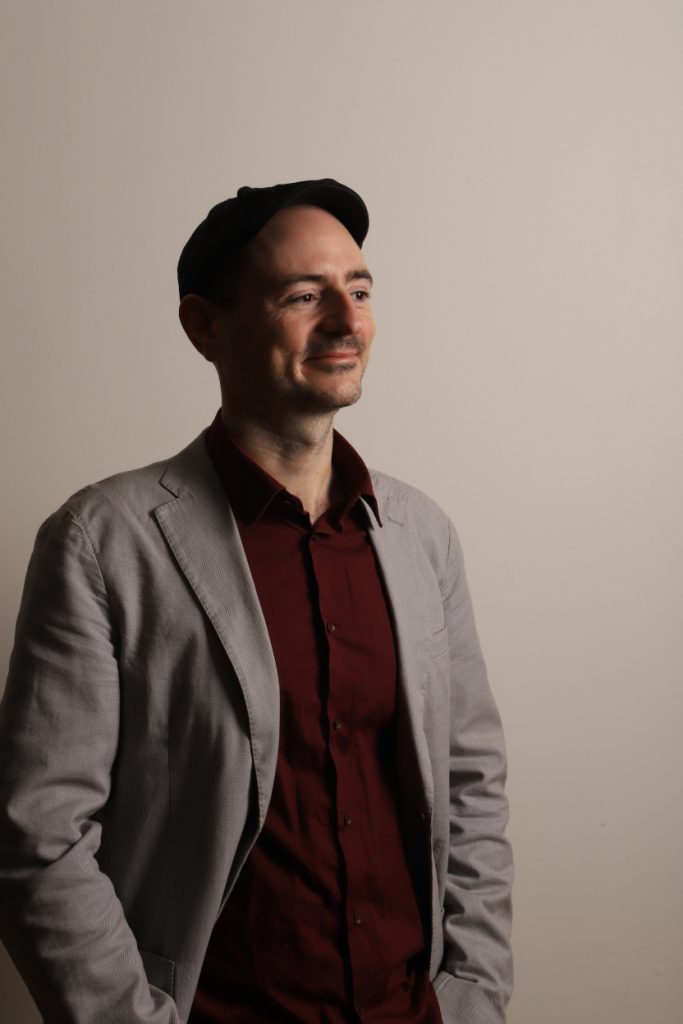
Simone Tolomeo
composer
Simone Tolomeo (b. 1985, Palermo) is a composer, bandoneonist, and pianist whose work bridges contemporary classical music, Mediterranean traditions, and a wide range of artistic influences. His musical education began at the Conservatorio Vincenzo Bellini in Palermo, where he studied piano and composition while cultivating an early interest in the dialogue between written music and oral traditions. In parallel, he pursued engineering and urban studies at INSA Lyon, earning a degree that continues to inform his artistic approach through methodological clarity and a multidisciplinary outlook.
Tolomeo later moved to Buenos Aires, where he refined his bandoneon practice with Federico Pereiro, Rodolfo Mederos, and Juan José Mosalini, and deepened his compositional training with Gabriel Senanes and Ramiro Gallo. Now based in Paris, he completed advanced studies in contemporary composition at the Schola Cantorum under Nicolas Bacri—graduating with distinction—and in orchestration with Anthony Girard at the École Cortot.
As a bandoneonist, he has performed in major venues such as the CCK, Usina del Arte, and Centro Cultural San Martín (Buenos Aires), and toured extensively in Europe and Asia, including a series of performances in Japan with the No Tags–Azimut Project. He has collaborated with artists including tenor Fabio Armiliato and participated in numerous recordings, notably with the Quartet Murgier and the trio Los Milonguitas, with whom he performed more than 1,000 concerts between 2016 and 2024.
As a composer, his works have been heard internationally at venues including the Philharmonie de Paris, Salle Molière (Lyon), Philharmonie of Kaluga (Russia), and the Münchner Philharmoniker (Germany). From 2022 to 2023 he was Artist-in-Residence with the association Le Chant des Hommes in Bois-Colombes, composing several chamber pieces including his String Quartet No. 1 (Op. 5) and Piano Quintet (Op. 6). Between 2023 and 2024 he served as Composer-in-Residence with the Orchestre de Chambre de Lyon under Vincent Balse, creating La Strada di Gino, a symphonic overture dedicated to surgeon and humanitarian activist Gino Strada. Rooted in the paradigm of microhistory, the piece explores the civic resonance of individual action—a theme Tolomeo revisits across his oeuvre.
In 2024, the Festival Sanary en Musique commissioned Ad Ora Incerta (Op. 9), an octet inspired by Primo Levi’s poetic cycle and conceived in dialogue with Schubert’s Octet D.803. In 2025 he composed Ressac – String Quartet No. 2 (Op. 11), commissioned by the Festival Collectif Roulotte and inspired by Rita Letendre’s painting of the same name. The piece evokes the perpetual cycle of surging and receding waves—an allegory of tension and release, destruction and renewal. The same year saw the creation of La Violetta d’Alcamo – Symphony for String Orchestra (Op. 12), commissioned by Ensemble ConTempo, which Tolomeo directs artistically. Dedicated to Franca Viola, a seminal figure of the fight against gender-based violence, the symphony was premiered in Paris and will be performed in New York in June 2026 by the North/South Consonance Ensemble under Max Lifchitz.
In August 2025, he premiered Anésthema (Op. 13), a symphonic overture for string orchestra commissioned by the Collectif Fractales for the Festival Sanary en Musique. Through stark contrasts of density, silence, and suspended gestures, the work explores states of shock, immobility, and awakening.
His discography includes a first chamber music album with Ensemble ConTempo (2023) and the 2025 release of his Quintet for Bandoneon and String Quartet (Op. 7), a 23-minute work that reframes the bandoneon within a contemporary classical context.
In 2025, Tolomeo was selected by the Orchestre National de Bretagne for a major symphonic commission on the theme of the sea and marine pollution, marking his appointment as Composer-in-Residence for the 2027–2028 season.
As Artistic Director of Ensemble ConTempo, Tolomeo advocates for an inclusive and non-elitist vision of contemporary music. His work seeks to connect memory and modernity, scholarly rigor and popular roots, placing social engagement and living creation at the center of his artistic practice.